
How Thickness Affects Pipe Strength
A Practical Buyer Guide by KAD India
In stainless steel welded pipes, thickness is not just a specification—it directly determines how much load, pressure, and stress a pipe can safely handle. Many buyers focus on diameter and grade but underestimate how critical wall thickness is to overall performance.
This guide explains exactly how thickness impacts pipe strength, in a clear and practical way.
The Basic Principle
Pipe strength increases with wall thickness.
A thicker pipe wall means more material is available to resist:
- Internal pressure
- External loads
- Mechanical stress
- Corrosion over time
A thinner pipe reduces all of the above, even if the material grade remains the same.
Relationship Between Thickness and Pressure Capacity
One of the most important factors is how much internal pressure a pipe can withstand.
| Thickness | Pressure Handling Capacity |
|---|---|
| Lower thickness | Lower pressure resistance |
| Higher thickness | Higher pressure resistance |
In simple terms:
- Doubling thickness significantly increases pressure capacity
- Even a small reduction in thickness can reduce pressure tolerance noticeably
This is critical in applications like oil, gas, steam, and chemical lines.
Hoop Stress Explained Simply
When pressure builds inside a pipe, it creates outward force on the walls. This is called hoop stress.
The relationship is:
- Higher thickness → Lower stress on the pipe wall
- Lower thickness → Higher stress on the pipe wall
This means thinner pipes are more likely to deform, crack, or fail under pressure.
Impact on Load Bearing Strength
Thickness also affects how much external load a pipe can handle.
- Thicker pipes resist bending and deformation better
- Thinner pipes are more prone to denting, bending, or collapsing
This is especially important in:
- Structural applications
- Support systems
- Heavy-duty installations
Effect on Corrosion Life
Thickness plays a major role in how long a pipe lasts in corrosive environments.
- Thicker pipe = more material to withstand corrosion
- Thinner pipe = faster failure once corrosion starts
In industries like pharma, food, and chemicals, this directly affects service life and maintenance costs.
Weld Strength and Thickness
In welded pipes, thickness also impacts weld reliability.
- Thicker walls allow stronger, more stable welds
- Very thin pipes are more sensitive to welding defects
- Uneven thickness can weaken the weld zone
Consistency of thickness across the pipe is just as important as the value itself.
Real-World Example
| Nominal Thickness | Actual Thickness | Impact |
|---|---|---|
| 2.00 mm | 2.00 mm | Full strength performance |
| 2.00 mm | 1.80 mm | Reduced pressure capacity |
| 2.00 mm | 1.70 mm | High risk in critical use |
A difference of just 0.2–0.3 mm can significantly affect safety margins.
Where Thickness Matters Most
Thickness becomes critical in:
- High-pressure pipelines
- Chemical processing systems
- Steam and heat transfer lines
- Structural and load-bearing applications
- Hygienic industries requiring long life
In such cases, even small deviations are not acceptable.
Buyer Mistakes to Avoid
- Assuming nominal thickness equals actual thickness
- Ignoring minimum thickness guarantees
- Not checking tolerance limits
- Focusing only on price per kg
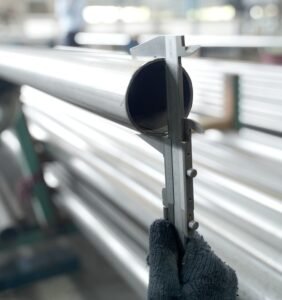
- Not verifying thickness at multiple points
These mistakes often lead to underperforming or unsafe installations.
KAD India Approach to Strength Assurance
At KAD India, we understand that thickness directly defines performance.
Our approach includes:
- Ensuring minimum actual thickness within strict tolerance
- Maintaining uniform thickness across the pipe
- Conducting proper testing and inspection
- Delivering material suitable for real-world stress conditions
This ensures that pipes perform as expected in demanding applications.
Key Takeaway
Thickness is one of the most critical factors in pipe strength.
- More thickness means more strength, safety, and life
- Less thickness increases risk, even if everything else is correct
For any serious application, always focus on actual thickness, not just nominal values.
KAD India recommends choosing pipes based on verified thickness to ensure long-term reliability and performance.
Also Read: Actual vs Nominal Thickness Explained for Buyers
